What is the first thing you notice about a person you have never met?
It could be their smile, their clothes, their voice, the way they walk. Sometimes it is something much simpler: their face. We do it without thinking. We look, register an image and move on. But imagine having to live with the knowledge that, wherever you go, people may stop at your face before they notice anything else about you.
That is the uncomfortable question at the centre of Before You See the Scar, a photographic and mixed-media project by visual artist Monica Dhaka, created in collaboration with acid attack survivors from the Brave Souls Foundation in Delhi. The project is concerned not only with what acid does to the body, but with what happens afterwards, when a scar becomes the first thing society sees and, often, the first thing it uses to define a person.
The difference is important. An acid attack is a violent event, but the exhibition is looking at the life that follows it. What happens when a woman wants to travel by bus, apply for a job, sit in a public place or simply walk down the road, and finds that her appearance has already shaped the way people respond to her? In the stories that form part of Dhaka’s project, the attack is only one part of the experience. The rest lies in the staring, the questions, the assumptions and the small humiliations that can become part of an ordinary day.
That is also why the title feels so direct. Before You See the Scar asks the viewer to think about what comes before that first reaction. Before the eye settles on damaged skin, there is a person. Before there is a story of violence, there is a life. And before someone becomes an “acid attack survivor” in the public imagination, she was already a daughter, student, wife, worker, artist, partner or simply a woman trying to get through her day.
Dhaka’s project begins with the body, but it does not stay there.
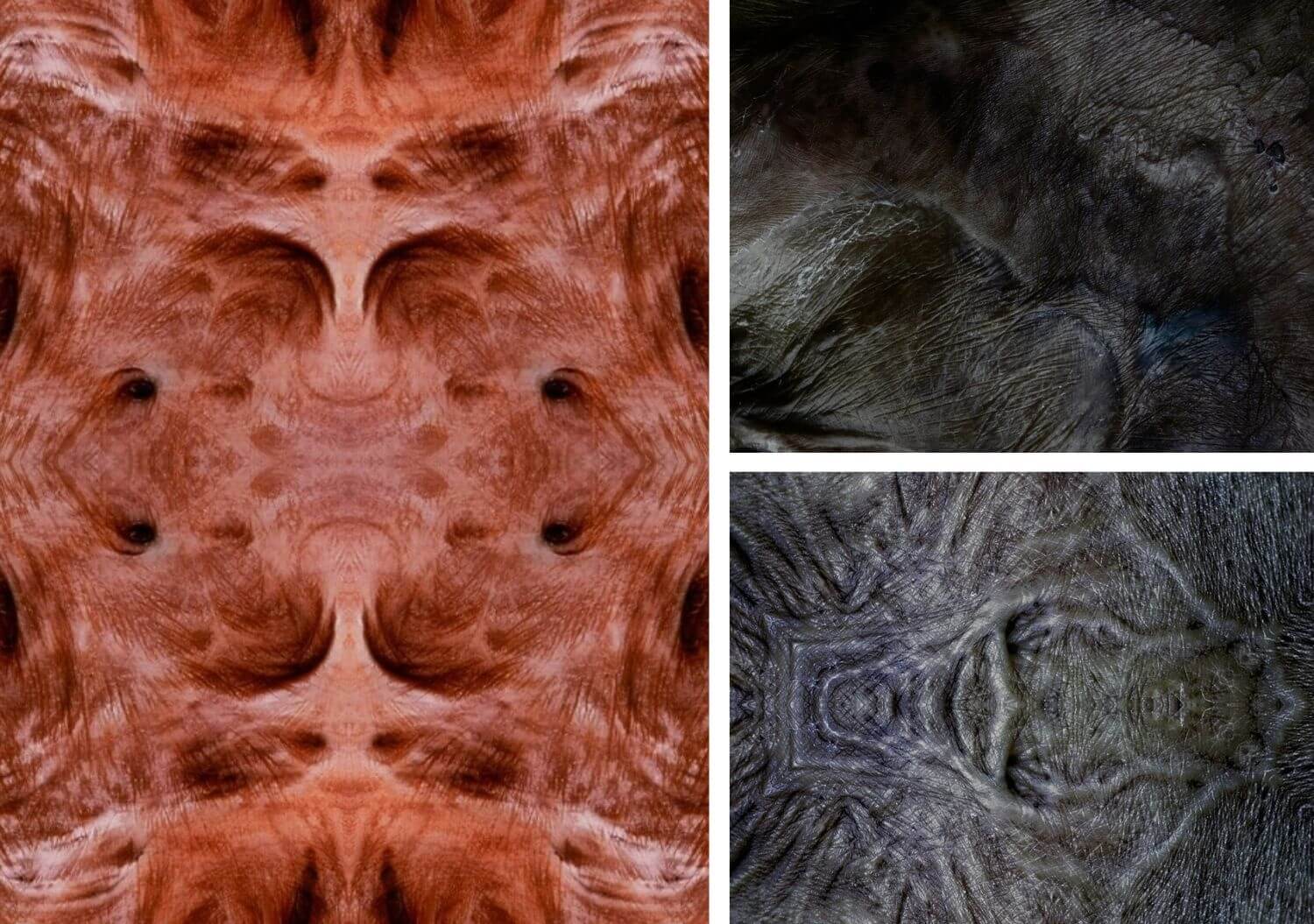
The first section uses extreme close-up photographs of burnt and scarred skin. These images are digitally manipulated through mirroring and repetition and turned into eight abstract patterns. Seen without context, they can look almost unfamiliar. Some resemble organic structures, textured surfaces or strange landscapes. The photographs are deliberately made to slow down the viewer’s first response. Instead of immediately recognising a scar, the eye is given time to notice shape, texture, symmetry and colour.
Then comes the information that changes everything: this is scarred skin.
The image has not necessarily changed. The viewer has. That small shift is central to the project. Dhaka is interested in how quickly we attach meaning to what we see and how easily that meaning changes when new information enters the picture. Her practice often begins with a physical mark and asks what happens when that mark is separated from the assumptions attached to it.
The series of Skin Landscapes works in a slightly different way. Here, the photographs of scarred skin are kept relatively close to their original form, with colour added rather than heavy manipulation. The folds and textures begin to resemble landscapes. They could be read as hills, valleys, rock or terrain before the viewer realises that the surface is actually skin.
There is no easy comfort in this beauty. It is not about making scars “beautiful” and moving on. The point is more complicated. What does the viewer see when there is no obvious story attached to the image? And how quickly does that perception change once the story becomes known?
Dhaka describes this process as a way of testing how context affects perception. She is interested in skin not only for what it carries, but also for the way it is judged. A scar may record violence, but it can also become the reason somebody is treated differently. By turning skin into patterns and landscapes, she temporarily removes the context that people usually bring to such images and makes us confront our own assumptions about looking.
But the exhibition eventually brings the viewer back to the women themselves.
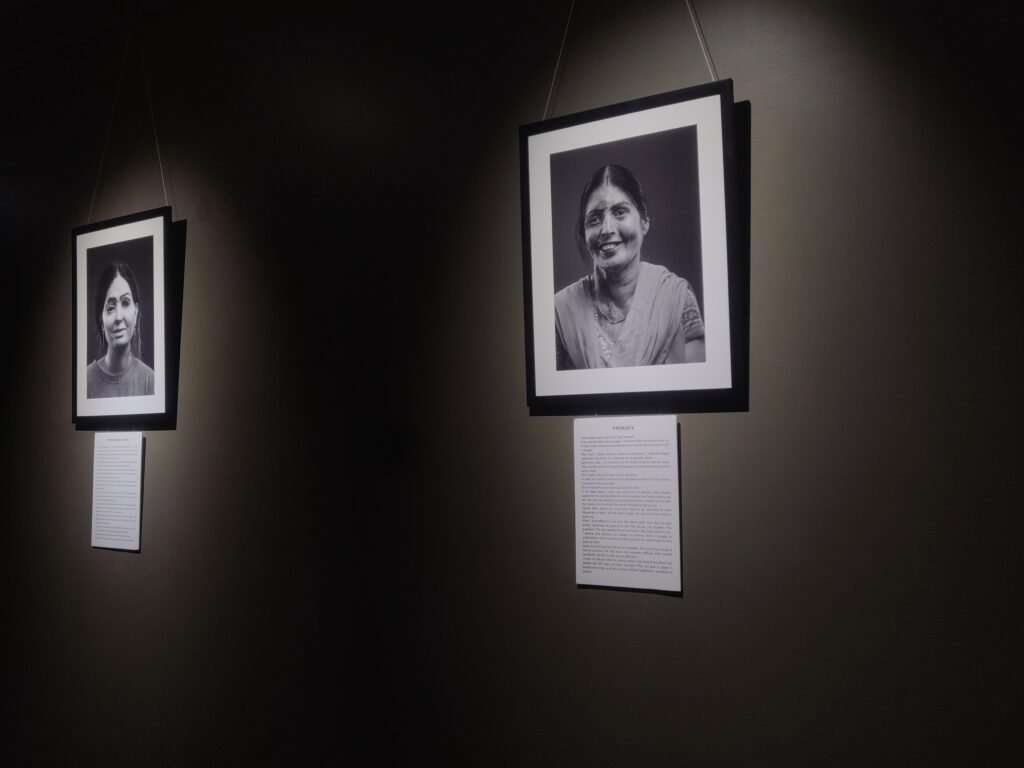
The second section consists of eight black-and-white portraits accompanied by texts shaped from interviews with the survivors. This is where the project moves from abstraction to individual lives. The women are named. Their experiences are written beside their portraits. They are no longer anonymous examples of a social issue. They are people explaining, in their own words, what happened to them and what they want others to understand.
The everyday details in these stories stay with you because they are not extraordinary.
Suniti talks about wanting to walk outside, sit in a park and eat ice cream. She wants people to speak to her normally. Her face has changed, but she does not believe that should change her right to live an ordinary life. After losing one eye and having very limited sight in the other following an acid attack by her husband, she has had to rebuild her life while dealing with people who continue to stare and judge her.
Pooja’s story shows how these judgements can affect work and independence. After an attack in 2005, she spent nearly two years mostly inside her home and stopped looking at herself in the mirror. When she later tried to find employment, she found that people often made up their minds about her appearance before asking about her education or abilities. She eventually found work at an Anganwadi centre, where she supports children and families.
The mirror becomes significant in these stories because it is not always strangers who are doing the looking. Constant exposure to other people’s reactions can change the way a person begins to see herself. Pooja describes avoiding her own reflection. Monika says she sometimes covers her face outside because she is tired of being stared at. Mumta says she does the same, not because she is ashamed of herself, but because being looked at has become difficult.
These are not dramatic moments in the way an attack is dramatic. They are smaller and quieter. That is exactly what makes them so revealing.
Preeti speaks about travelling in buses and shared transport where strangers have asked her to move or refused to sit beside her. She recalls neighbours complaining about her face and asking her to leave where she lived. The incidents may seem brief to someone witnessing them, but for the person experiencing them, they become part of a longer feeling of not belonging. She describes still laughing, worrying, hoping and feeling hurt, just as she did before the attack.
The project also shows how quickly curiosity can turn into humiliation. Shabnam describes strangers staring at her and nudging other people so they can look too. She has been called “bechari”, a word she strongly rejects. She does not want to be treated as helpless. She talks instead about drawing, healing and her wish to become an artist.
There is a recurring demand across these stories: do not stop at what happened to me.
Reshma Bano Qureshi, who later walked at New York Fashion Week, makes a distinction between public applause and ordinary acceptance. Being praised as “brave” does not stop people from staring. It does not automatically make daily life easier. Mumta speaks about wanting to work, be independent and sit in a public place without covering her face. Premlata, who has lived with the effects of an attack since 1984, talks about the staring, laughter and judgement that have continued over decades.
This is perhaps the most important part of Before You See the Scar. It does not present survival as a dramatic, neatly finished chapter. Survival here can be getting back to studying. It can mean finding a job. Looking after children. Drawing. Falling in love. Trying to leave the house without covering your face. Wanting to eat ice cream in a park without wondering who is looking.
The exhibition also pushes against the familiar way stories of trauma are often told. There is a temptation to focus entirely on pain because pain is easy to recognise. Dhaka’s project makes room for pain, but it refuses to let pain become the whole identity. Her artist statement says that she is interested in the way one visible feature, label or event can begin to stand in for an entire life. Her approach is rooted in research, conversations and collaboration, with the experiences of the people involved shaping the photographs, text and presentation.
Seen this way, the exhibition is not asking for a particular emotional response from the viewer. It is asking for attention.
Look at the photograph again. Read the words beside it. Notice the woman before the injury. Think about the ordinary things she is asking for and how little of them are really extraordinary: work, education, love, independence, dignity, the freedom to sit somewhere in public without becoming a spectacle.
That may be the simplest way to understand Before You See the Scar. The project begins with the scar because that is often where society begins. But it asks us not to end there.
About the artist
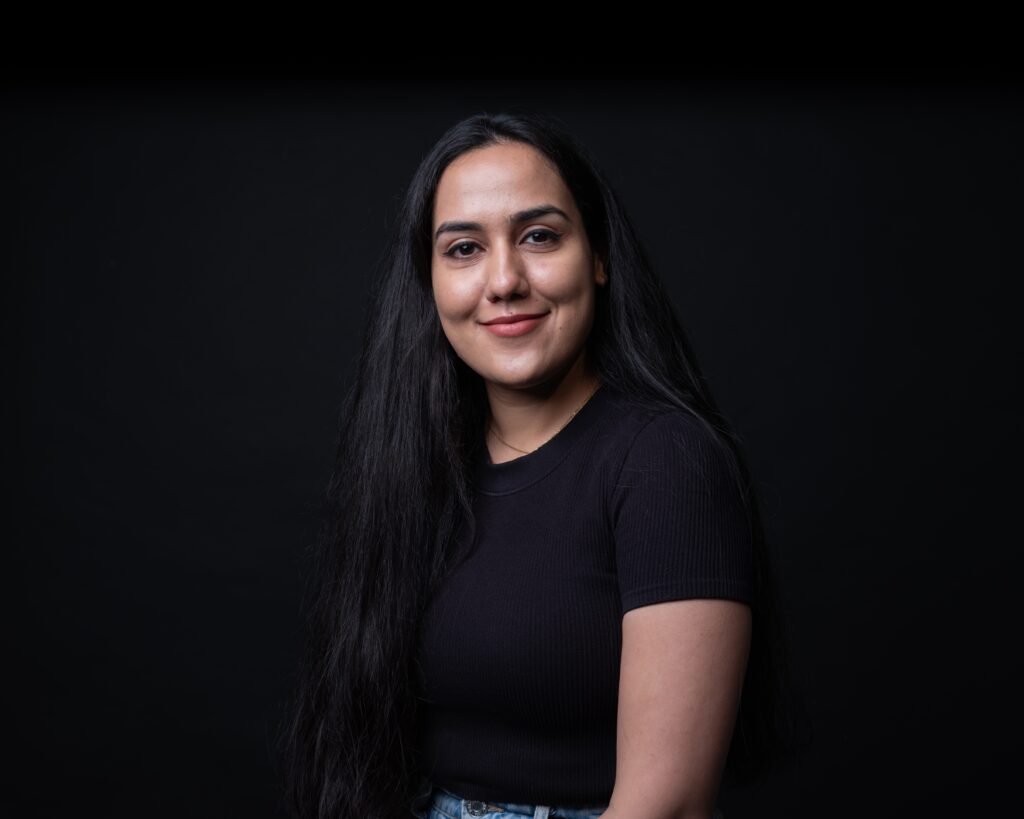
Monica Dhaka is an Indian visual artist working between Mumbai and London, primarily through photography and moving image. She holds a master’s degree from the London College of Communication, University of the Arts London. Her research led practice looks at identity, belonging, and the ways people are perceived through their bodies, communities, and backgrounds. Her other projects include The Pahalwan Who Stayed, which explores traditional mud wrestling culture in Delhi. Across her work, she is interested in what happens when the world decides what it sees first and what might change when we learn to look again.