

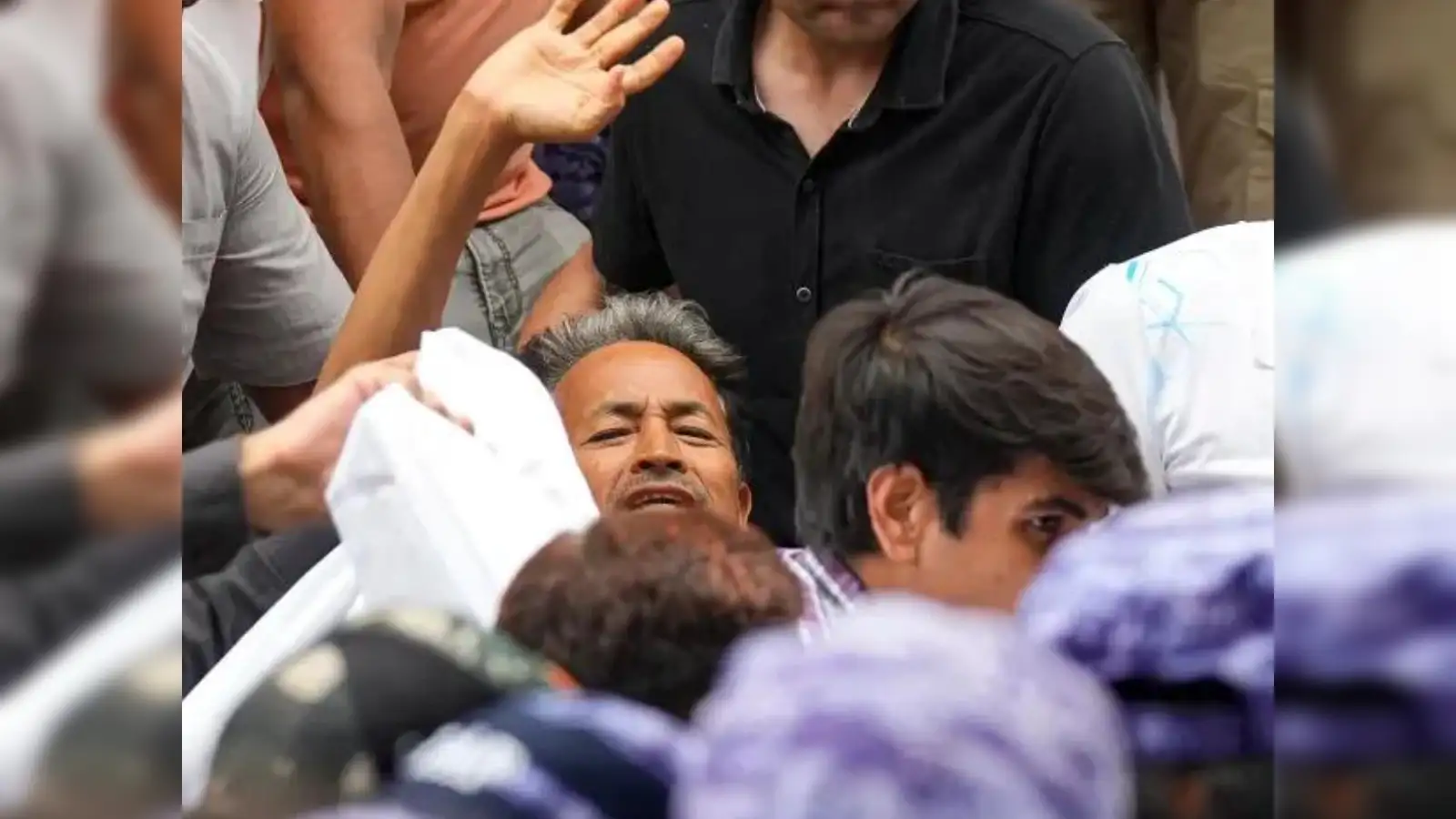
There is something deeply unsettling about a democracy feeling threatened by a man who has not eaten for weeks.
Sonam Wangchuk was not carrying weapons. He was not leading a violent uprising. He was not calling for hatred or unrest. He was sitting on a hunger strike, using perhaps the most Gandhian form of protest imaginable, placing his own body on the line to draw attention to issues he believes deserve urgent attention.
Yet, in the early hours of Saturday, videos emerged showing a visibly weak and exhausted Wangchuk being carried away by police personnel and shifted to Safdarjung Hospital. The images spread rapidly across social media. They were difficult to watch.
A man who had spent nearly three weeks fasting was too weak to walk on his own.
And the state responded not with dialogue, but with police intervention. It was the removal of a protest.
The visuals have resonated so strongly because they represent something much larger than one individual. They point to a growing pattern in which peaceful dissent is increasingly treated as an inconvenience rather than an essential part of democratic life.
A hunger strike occupies a sacred place in India’s political history.
From Mahatma Gandhi to Potti Sriramulu, fasting has long been used as a moral appeal against structures of power. It is one of the few forms of protest that relies entirely on non violence and personal sacrifice. It demands attention not through force but through conscience.
When even this form of dissent begins to be met with police barricades, detentions, and forceful removals, it raises an uncomfortable questions?
What forms of protest are still acceptable?
The images from Jantar Mantar have therefore struck a nerve because they seem symbolic of a broader democratic anxiety.
Across the world, governments increasingly celebrate dissent in theory while becoming intolerant of it in practice. Protesters are often praised retrospectively, after history vindicates them, but are treated with suspicion and hostility in the present.
Wangchuk’s treatment appears to fit into that troubling pattern. If an activist as widely respected as Sonam Wangchuk can be physically removed/abducted while peacefully fasting, what does that mean for ordinary citizens whose voices are far less visible? A hunger strike is, by its very nature, an act of vulnerability. It is a person saying, “I have no institutional power, no wealth, no machinery of influence.” All I have is my body and my conscience. For a state to respond to such vulnerability with force inevitably creates troubling optics. It risks conveying the impression that dissent itself has become intolerable. The incident also reminds us of a larger truth.
Democracy is not measured by how comfortably governments handle praise. It is measured by how they respond to criticism. It is measured by whether people can raise uncomfortable questions without fear of suppression or removal. And it is measured by whether peaceful resistance is respected, even when it is inconvenient.
The scenes from Jantar Mantar should therefore concern anyone who values democratic principles.
Because if a fasting protester can be treated as a problem to be managed rather than a citizen to be heard, then something fundamental begins to erode. Why the response appeared more focused on ending the protest than addressing the grievances that gave rise to it?
History repeatedly shows that governments often underestimate the moral power of peaceful resistance. Removing a protester from a site does not necessarily end a movement.
Sometimes, it amplifies it. A generation already burdened by unemployment, rising competition, and an increasingly precarious future is now being told that even peaceful expressions of anger may be treated as a law-and-order problem. The images from Delhi, therefore, symbolise more than the removal of one activist. They symbolise a state that appears increasingly uncomfortable with young people asking difficult questions.
There is a tragic irony here.
India often celebrates its youth as the engine of the nation’s future. Politicians routinely speak of demographic dividends and the promise of young India. But when students take to the streets demanding fairness, transparency, and accountability, they frequently encounter surveillance, restrictions, and police intervention instead of dialogue.
The message this sends is deeply troubling.
It suggests that young people are expected to remain aspirational but not political, ambitious but not angry, engaged but not dissenting.
The images of Sonam Wangchuk being carried away have already traveled far beyond Jantar Mantar. They have entered public memory. They have become symbols of a larger debate about democracy, dissent, and state power.
A society should be worried when a man on hunger strike appears threatening.
Because if even non violent protest is treated with suspicion, then the space for democratic expression begins to shrink.
And democracies rarely weaken overnight. They weaken gradually, one ignored voice, one silenced protest, and one unsettling image at a time.


